Scaling commercial food production is not simply a matter of buying larger mixers or adding another shift. It requires a controlled transition from a reliable small operation to a repeatable, measurable system. This guide explores how to scale up commercial food production while protecting product quality, worker safety, and customer trust. It examines capacity planning, equipment selection, facility flow, staffing, supplier controls, and cold-chain performance. A successful expansion should feel predictable on a busy Friday, not only during a quiet trial run.
Food safety must remain the operating foundation. Frank Yiannas, former FDA Deputy Commissioner for Food Policy and Response, has emphasized, “Food safety is a shared responsibility.” That principle affects every production stage, from receiving ingredients to cleaning contact surfaces and recording batch temperatures. Strong traceability can connect a finished carton to its ingredients, operator, line, and production time. Preventive controls, validated processes, documented sanitation, and routine environmental monitoring also support dependable growth. These practices may appear slow at first. They often prevent expensive recalls later.
The following sections present practical ways to increase output without creating hidden weaknesses. They cover line balancing, automation, workforce training, demand forecasting, energy use, packaging, and quality assurance. Real facilities rarely scale perfectly. Equipment may arrive late, forecasts may be wrong, and a faster line may expose an overlooked bottleneck. That is useful information, if leaders measure it honestly. Scaling should therefore include pilot runs, downtime reviews, maintenance planning, and clear stop-work decisions. More volume is not the only goal. Safer, consistent, and financially sustainable production matters more.
Assessing Production Capacity, Market Demand, and Scaling Requirements
Commercial food production should scale from evidence, not optimism.
The OECD-FAO Agricultural Outlook 2024–2033 projects global agricultural and fish production to grow by
1.1% annually through 2033.
That growth remains uneven across regions and product categories. A facility producing
20,000 meals weekly
should measure real throughput by shift, changeover time, sanitation delays, labor coverage, and cold-storage capacity.
Nominal line speed is not usable capacity.
Demand validation requires equal discipline.
The FAO Food Outlook 2024 reports continued pressure from food-price volatility and supply risks, making volume forecasts less reliable than they appear.
Review customer orders, repeat rates, seasonal demand, and distributor withdrawals before adding another production line.
The International Food Information Council’s 2024 consumer research identifies
price, health, and convenience
as major purchasing influences.
Demand is layered.
Scaling also requires stronger utilities, quality controls, traceability, packaging, and working capital.
The United Nations Environment Programme’s Food Waste Index Report 2024 estimates that
1.05 billion tonnes of food were wasted in 2022.
Poor planning is expensive.
A
10–20% capacity pilot
can expose hidden constraints before major investment.
Small tests matter.
Forecasts can fail. Rejected batches, maintenance delays, and ingredient shortages need visible buffers.
A spreadsheet cannot predict every failed seal.
Designing Efficient Facilities, Equipment, and Production Workflows
2026 Top Ways to Scale Up Commercial Food Production
Designing Efficient Facilities, Equipment, and Production Workflows
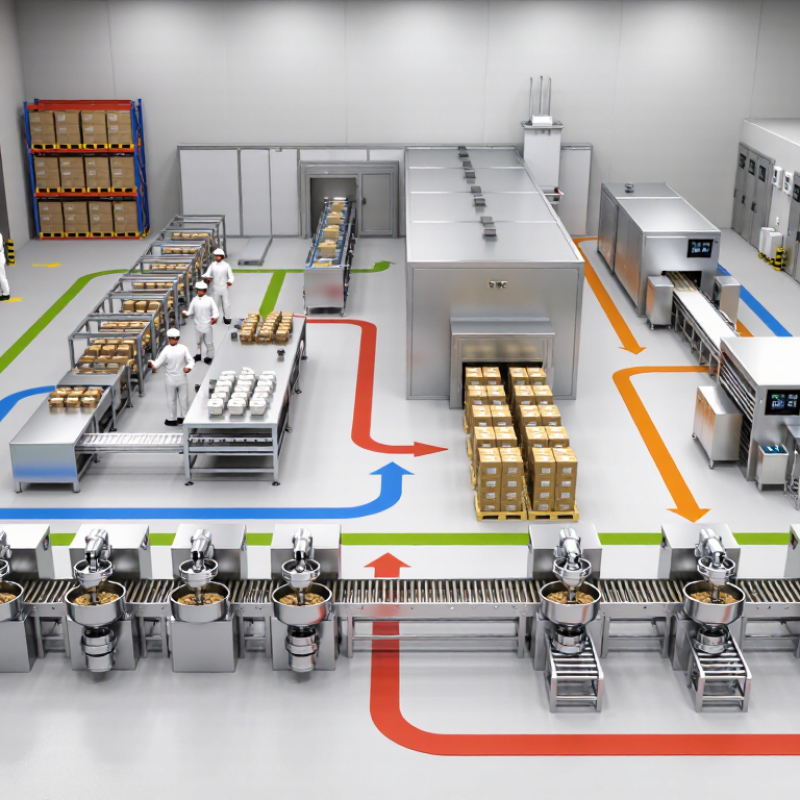
Scaling commercial food production starts with facility design, not larger machines. A practical layout separates raw materials, processing areas, packaging, and finished goods. This reduces cross-contact risks and unnecessary movement. Clear floor markings help operators understand each route. Keep handwashing stations near high-traffic entrances. They must be easy to reach.
Equipment should match real production demand, not optimistic forecasts. Select systems with adjustable speeds, quick changeover parts, and accessible cleaning points. Leave enough space around motors, conveyors, and control panels for maintenance. I have seen crowded installations create avoidable delays. The original plan looked efficient. Daily repairs proved otherwise. Utility capacity also matters, especially for water, drainage, ventilation, and temperature control.
Production workflows need visible checkpoints. Operators can record receiving temperatures, batch numbers, cooking conditions, and packing times. Simple digital records improve traceability when information remains accurate and easy to review. Train teams beside the actual equipment, using realistic product loads. A small trial run can expose awkward movements, unstable containers, or confusing instructions. Do not hide those flaws. Revise the workflow before expanding volume. Continuous improvement is useful, but it is rarely neat or immediate.
2026 Top Ways to Scale Up Commercial Food Production
Designing Efficient Facilities, Equipment, and Production Workflows
Scalable food facilities should integrate rapid chilling, reliable hot-holding equipment, continuous temperature monitoring, and clearly separated process zones. The chart shows key temperature limits for time/temperature control for safety foods under the U.S. FDA Food Code: cold holding at 41°F or below, hot holding at 135°F or above, and cooling from 135°F to 70°F within two hours before reaching 41°F within an additional four hours.
Source: U.S. FDA Food Code 2022, Sections 3-501.14 and 3-501.16. Local regulations may vary.
Implementing Automation, Digital Systems, and Process Standardization
2026 Top Ways to Scale Up Commercial Food Production
Implementing Automation, Digital Systems, and Process Standardization
Scaling commercial food production requires more than adding equipment. Automation should remove repetitive work while protecting product quality and worker safety. Start with clear targets, such as reducing filling errors, shortening changeover time, or lowering waste. A timed conveyor, automated dosing unit, or temperature sensor can create measurable improvements. Keep learning.
Digital systems connect production data across receiving, preparation, cooking, cooling, and packing. Operators can record batch numbers, temperatures, cleaning checks, and maintenance events on shared digital forms. Managers then review trends instead of relying on memory or scattered paperwork. This improves traceability and supports evidence-based decisions. Access controls and regular data backups also protect record reliability. However, poor data entry can weaken the entire system. A fast tablet does not fix unclear instructions.
Process standardization turns good practice into repeatable practice. Each task should have a concise procedure, defined limits, visual checks, and a response for deviations. Training should include real equipment, sample records, and short competency tests. Standardized changeover steps can prevent allergen cross-contact and reduce downtime when teams rotate. Review procedures after equipment changes, customer complaints, or failed quality checks. No system is perfect. A mature operation leaves room for worker feedback and controlled improvement, rather than treating every procedure as permanent.
Strengthening Food Safety, Quality Control, and Regulatory Compliance
Scaling commercial food production is not only about faster lines or larger facilities. It requires a control system that grows with daily output. In practice, food safety teams should map each process step, from receiving chilled ingredients to sealing finished cases. Hazard analysis can identify microbial, allergen, chemical, and physical risks. Critical limits must be measurable, such as cooking temperature, cooling time, or sanitizer concentration. Staff need clear records, not vague instructions. A missing entry can weaken an otherwise strong batch release decision.
Quality control should combine routine testing with disciplined observation. Calibrated thermometers, metal detection checks, environmental swabs, and weight verification create useful evidence. Traceability software or paper logs should link raw materials, operators, equipment, and shipment dates. Regulatory compliance also demands controlled procedures, training records, corrective actions, and internal audits. Requirements differ by market, so a qualified compliance professional should review the site plan before expansion. Experience shows that rushed growth exposes small gaps. A poorly labeled allergen container can stop production and damage consumer trust. No system is flawless.
Tips: Begin with a pilot line. Test sanitation schedules under real production pressure. Review records at the end of every shift. Investigate repeated deviations instead of simply retraining staff. Keep emergency contacts visible near production boards. Invite an independent auditor when results look unusually perfect. That step may feel unnecessary, but it can reveal blind spots.
Managing Supply Chains, Workforce Growth, and Sustainable Expansion
2026 Top Ways to Scale Up Commercial Food Production
Commercial food production in 2026 will scale through control, not speed alone. A practical supply chain starts with a weekly map of ingredients, lead times, storage temperatures, and backup routes. Operations teams can connect purchase forecasts to actual orders, then review the gaps every Friday. A 12-hour delay in chilled vegetables can disrupt preparation, staffing, and delivery windows. Keep alternatives tested. One supplier may look efficient until a harvest failure exposes the weakness. Safety stock should reflect shelf life, cash flow, and seasonal risk, rather than a fixed percentage. This is where many plans become too optimistic.
Workforce growth needs the same discipline. New employees should learn allergen controls, sanitation checks, equipment handling, and escalation steps on the floor. Short video modules help, but supervised practice catches mistakes that quizzes miss. Cross-training two people per critical station reduces stoppages during absences or demand spikes. Still, hiring faster can weaken culture. Managers need realistic shift plans, fair workloads, and a channel for reporting near misses without fear. Sustainable expansion also means measuring water, energy, packaging, and food waste per finished unit. Install efficient equipment only after checking maintenance skills and local utility capacity. A lower-energy machine is not sustainable if it sits idle for months. That uncomfortable review matters.
FAQS
Design separate zones for raw materials, processing, packaging, and finished goods. Keep routes clear. Larger machines cannot fix poor movement.
Use clear floor markings and separate material flows. Place handwashing stations near busy entrances. They must be easy to reach.
Choose adjustable speeds, quick-change parts, and accessible cleaning points. Leave space around motors, conveyors, and control panels. Crowded layouts often create repair delays.
Check water, drainage, ventilation, and temperature-control capacity. An efficient machine may remain idle without suitable utilities. That oversight is costly.
Record receiving temperatures, batch numbers, cooking conditions, and packing times. Keep records simple and easy to review. Inaccurate data defeats the system.
Trial runs reveal awkward movements, unstable containers, and confusing instructions. Test realistic product loads. Do not hide weak points.
Map ingredient lead times, storage temperatures, and backup routes weekly. Test alternative suppliers before disruption occurs. One source may look reliable until harvest problems appear.
Consider shelf life, cash flow, seasonal risk, and actual orders. Avoid using one fixed percentage for everything. That estimate may fail.
Train employees on allergen controls, sanitation, equipment handling, and escalation steps. Combine short videos with supervised floor practice. Quizzes alone miss practical mistakes.
Measure water, energy, packaging, and food waste per finished unit. Check maintenance skills before installing efficient equipment. Lower energy use means little if equipment sits unused.
Conclusion
Scaling commercial food production requires more than simply increasing output. The first step is to evaluate current production capacity, forecast market demand, and identify the facilities, equipment, staffing, and capital needed for sustainable growth. Efficient facility layouts, reliable machinery, and streamlined workflows can reduce delays, improve resource use, and support consistent production as volume increases.
A practical approach to how to scale up commercial food production also includes automation, connected digital systems, and standardized procedures that make operations easier to monitor and replicate. Strong food safety programs, quality control checkpoints, accurate records, and regulatory compliance should remain central throughout expansion. At the same time, businesses need resilient supply chains, effective workforce training, responsible hiring, and sustainability measures that limit waste and energy use. By coordinating these elements, food producers can expand efficiently while protecting product quality, operational stability, employee safety, and long-term business performance.

 Chef Nest Kitchen